

C- The Comforting Shelf
The herbs gathered beneath the letter C speak of comfort, courage, cleansing, and quiet restoration.
Here we find familiar garden companions, woodland allies, and plants long cherished for their ability to soothe, nourish, and strengthen. Some offer gentle protection, some encourage renewal, and others remind us that healing is often found in the simple rhythms of the natural world.
As with all entries within the Keeper's Shelf, these plants are offered as an invitation to learn their stories, honour their traditions, and deepen your relationship with the living wisdom they carry.

Cacao
Theobroma cacao
Element: Earth + Fire
Threshold: A sacred seed of heart and spirit, inviting warmth, connection, and the quiet remembering of joy
Keeper’s Note
Cacao has been cherished for thousands of years as both food and ceremony. Growing from the trunk of a tropical tree, its pods hold seeds that have nourished bodies, marked celebrations, and accompanied sacred gatherings across generations. Rich, warming, and deeply comforting, Cacao reminds us that nourishment can be both physical and emotional — feeding not only the body, but also the heart.
Traditional Uses
Cacao has traditionally been prepared as a nourishing beverage, food, and ceremonial drink. Rich in naturally occurring minerals and plant compounds, it has long been valued for its uplifting and energizing qualities. In many traditions, Cacao is associated with connection, gratitude, creativity, and moments of reflection shared in community.
Where It Grows
Cacao is native to the tropical rainforests of Central and South America and is now cultivated throughout many warm, humid regions of the world. It grows best beneath the shelter of taller trees, thriving in rich soil, consistent moisture, and year-round warmth. The colourful seed pods grow directly from the trunk and larger branches of the tree.
How to Harvest
Cacao pods are harvested when fully mature and richly coloured, then carefully cut from the tree by hand. The seeds are removed from the pods, fermented, dried, and processed to develop the familiar flavour and aroma associated with cacao. Traditional harvesting relies on careful handling of both the tree and the developing fruit.
Gentle Safety Note
Cacao is generally enjoyed safely as a food and beverage. Because it naturally contains caffeine and theobromine, some individuals may be sensitive to large amounts. Use moderation if sensitive to stimulants, managing certain heart conditions, or taking medications. As with any food or herb, use caution with allergies, pregnancy, nursing, or ongoing health concerns.
Find this herb in:
Digestive & Gut Support
Cold, Flu & Respiratory

Calamus
Acorus calamus
Element: Water + Air
Threshold: A reed of clarity and awakening, growing where water meets land and reminding us to move through life with presence and purpose.
Keeper’s Note
Calamus is a striking wetland plant with long, sword-like leaves and an aromatic root that has been treasured for centuries. Found along the edges of ponds, marshes, and slow-moving waterways, it has long been associated with clarity, focus, and the sharpening of the senses. There is a bright, attentive quality about Calamus, encouraging us to notice what has been overlooked and listen more closely to the wisdom around us.
Traditional Uses
Calamus root has a long history of traditional use in herbalism and was valued for supporting digestion and general vitality. The fragrant root was often prepared as teas, tinctures, and aromatic preparations, while pieces of the dried rhizome were sometimes carried or chewed for their distinctive scent. Across many traditions, Calamus became known as a plant associated with alertness, clarity, and mindful awareness.
Where It Grows
Calamus grows in wetlands throughout parts of North America, Europe, and Asia. It thrives along pond margins, marshes, stream banks, and other consistently moist environments where its roots remain anchored in shallow water or saturated soil. Its tall green leaves often grow in dense stands, making it easy to spot in suitable habitats.
How to Harvest
The rhizomes are traditionally harvested in autumn or early spring when the plant's energy is concentrated below ground. Carefully lift a portion of the rhizome, leaving enough behind for the colony to continue growing. Wash thoroughly, trim away damaged sections, and dry in a warm, airy location if preserving for later use.
Gentle Safety Note
Calamus has a long history of traditional use, but not all varieties are considered interchangeable, and modern regulations differ between regions. Because certain forms contain compounds of concern, internal use should be approached thoughtfully and only with appropriate knowledge. Use caution during pregnancy, nursing, with medications, or ongoing health conditions, and ensure proper identification before harvesting from the wild.

Keeper’s Note
Calendula is one of the most beloved herbs of the cottage garden, easily recognized by its cheerful golden-orange blossoms that seem to capture sunlight within their petals. Long treasured by herbalists, gardeners, and healers, it is a plant associated with soothing, mending, and gentle care. There is a nurturing presence about Calendula, offering the reminder that healing does not always need to be forceful — sometimes it arrives through tenderness, patience, and steady support.
Traditional Uses
Calendula flowers have traditionally been used to support skin health and comfort. The blossoms are commonly infused into oils, salves, creams, washes, and herbal preparations intended to soothe dry, irritated, or sensitive skin. Calendula has also been enjoyed as a tea and included in traditional herbal blends for general wellness and gentle digestive support.
Where It Grows
Calendula is native to the Mediterranean region but is now cultivated in gardens around the world. It thrives in full sun and well-drained soil, blooming generously from early summer until frost. Its bright flowers attract pollinators and often continue producing blossoms when harvested regularly.
How to Harvest
Harvest the flowers on a dry day after the morning dew has evaporated. Pick blossoms that are fully open and vibrant, gathering regularly to encourage continued flowering throughout the season. The flower heads may be used fresh or dried in a warm, shaded location with good airflow to preserve their colour and potency.
Gentle Safety Note
Calendula is generally considered one of the gentlest herbs in the apothecary and is widely used for both topical and traditional internal preparations. Those with allergies to plants in the daisy family (Asteraceae) should use caution, as sensitivity may occur. As with any herb, use care during pregnancy, nursing, with medications, or ongoing health conditions.

Camphor
Camphora officinarum
Element: Air + Fire
Threshold: A fragrant tree of clarity and purification, carrying the feeling of fresh air after a long storm.
Keeper’s Note
Camphor is an evergreen tree prized for the aromatic compounds found within its wood and leaves. For generations, its distinctive scent has been associated with cleansing, protection, and renewed vitality. There is an invigorating quality about Camphor, awakening the senses and reminding us of the power of clear spaces, deep breaths, and fresh beginnings.
Traditional Uses
Camphor has traditionally been used in aromatic preparations, liniments, balms, and salves intended to provide a cooling sensation and support comfort for tired muscles and joints. Its strong scent has also been valued in household and ceremonial practices, where it was used to freshen spaces and discourage insects. Historically, Camphor was appreciated more for its external and aromatic applications than as an internal remedy.
Where It Grows
Camphor is native to China, Taiwan, Japan, and other parts of eastern Asia. It thrives in warm climates with well-drained soil and can grow into a large, long-lived evergreen tree. Today it is cultivated in many subtropical and temperate regions around the world for its ornamental beauty and aromatic qualities.
How to Harvest
Traditionally, Camphor was obtained from the wood, roots, and leaves of mature trees through a process of steam distillation. For home herbalists, the leaves are the most accessible part of the plant and may be gathered from healthy trees as needed. Harvest respectfully, taking only small amounts and allowing the tree to continue thriving.
Gentle Safety Note
Camphor is intended primarily for external and aromatic use. Concentrated camphor products can be toxic if swallowed and should be kept away from children and pets. Avoid applying concentrated preparations to broken skin, and use caution during pregnancy, nursing, with medications, or ongoing health conditions. Always follow product directions and use only appropriately prepared Camphor products.

Cardamom
Elletaria cardamomum
Element: Fire + Air
Threshold: A fragrant seed of warmth and brightness, bringing comfort to the body and lightness to the spirit.
Keeper’s Note
Cardamom is one of the world's most treasured spices, prized for its sweet, aromatic scent and distinctive flavour. Growing among the lush forests of southern India and tropical Asia, it has travelled across continents for centuries, finding a place in kitchens, apothecaries, and traditions alike. There is a welcoming quality about Cardamom, offering warmth without heaviness and reminding us that small things often carry remarkable gifts.
Traditional Uses
Cardamom has traditionally been used to support healthy digestion and freshen the breath. The aromatic seeds have long been added to teas, foods, herbal preparations, and spice blends, where they were valued for their warming and comforting qualities. Throughout many traditional healing systems, Cardamom was appreciated as a gentle digestive ally and uplifting culinary herb.
Where It Grows
Cardamom is native to the tropical forests of southern India and Sri Lanka and is now cultivated throughout many warm, humid regions of the world. It thrives in rich soil, filtered sunlight, and abundant moisture, growing as a leafy perennial with tall stems and clusters of pale flowers that produce the familiar seed pods.
How to Harvest
The seed pods are harvested by hand as they begin to ripen but before they fully split open. After harvesting, the pods are carefully dried to preserve their flavour and aroma. The seeds may be used whole, crushed, or freshly ground depending on the preparation.
Gentle Safety Note
Cardamom is generally considered a safe culinary herb and spice when used in traditional food amounts. As with any botanical, use caution if you have known allergies, are pregnant or nursing, take medications, or have ongoing health concerns. Seek professional guidance before using concentrated extracts or essential oils internally.

Cascara Segrada
Ramnus Pershiana
Element: Earth
Threshold: A golden bloom of comfort and restoration, carrying warmth where healing is needed most.
Keeper’s Note
Cascara is a small tree native to the forests of western North America, where it grows quietly among conifers and along moist woodland slopes. Its bark has been valued for generations and became one of the most widely recognized traditional herbal preparations of the late nineteenth and early twentieth centuries. There is a steady, purposeful nature about Cascara, reminding us that balance is often restored not through force, but through gentle encouragement.
Traditional Uses
Cascara bark has a long history of traditional use for supporting regular bowel function and encouraging natural elimination. Historically, the aged bark was prepared as teas, extracts, and tinctures and was valued as a dependable herbal ally when occasional support was needed. Traditional herbalists took care to properly age the bark before use, as freshly harvested bark was considered too strong.
Where It Grows
Cascara is native to the Pacific Northwest of North America, ranging from British Columbia south into parts of California and inland through the Rocky Mountain regions. It grows in moist forests, woodland clearings, streamside habitats, and mountain slopes, preferring rich soil and partial shade.
How to Harvest
Traditionally, the bark was harvested from mature trees during the spring or early summer when it separated more easily from the trunk and branches. The bark was then carefully dried and aged for at least a year before use. Sustainable harvesting is essential, as excessive bark removal can harm or kill the tree. Whenever possible, source Cascara from responsibly managed suppliers rather than harvesting from wild populations.
Gentle Safety Note
Cascara is a traditional herb with specific uses and should be approached thoughtfully. Fresh bark should never be used, as it may cause significant digestive discomfort. Prolonged or excessive use is not recommended. Avoid during pregnancy, nursing, intestinal inflammation, bowel obstruction, or when taking medications unless guided by a qualified healthcare practitioner.

Catnip
Nepeta cataria
Element: Air + Water
Threshold: A gentle herb of comfort and calm, inviting moments of rest, playfulness, and peaceful reflection.
Keeper’s Note
Catnip is a familiar member of the mint family, recognized by its soft grey-green leaves, delicate white flowers, and unmistakable charm. While famous for the delight it brings to cats, it has been equally treasured by herbalists for centuries as a comforting herb for people. There is a light-hearted spirit about Catnip, reminding us that relaxation is not idleness, but an important part of living well.
Traditional Uses
Catnip has traditionally been used to encourage relaxation and support the body's natural response to occasional nervous tension. It has long been prepared as a gentle tea to promote restful sleep, digestive comfort, and overall well-being. In folk herbalism, Catnip was often given as a soothing herb for both children and adults and was valued for its calming nature.
Where It Grows
Catnip is native to Europe and Asia but has become naturalized throughout much of North America. It thrives in full sun to partial shade and grows happily in gardens, meadows, roadsides, and disturbed soils. As a hardy perennial, it readily reseeds itself and attracts bees, butterflies, and other beneficial pollinators.
How to Harvest
Harvest the flowering tops and leaves just as the first blossoms begin to open, when the aromatic oils are at their peak. Gather on a dry morning after the dew has evaporated, taking only what is needed while leaving plenty of flowers for pollinators. Hang the stems in small bundles to dry in a warm, well-ventilated space away from direct sunlight.
Gentle Safety Note
Catnip is generally considered a gentle herb when used in traditional amounts. Because it may encourage relaxation, use caution before driving or operating machinery until you know how it affects you. As with any herb, use care during pregnancy, nursing, with medications, or ongoing health conditions, and ensure proper identification before harvesting from the wild.

Cat's Claw
Uncaria tomentosa
Element: Earth + Water
Threshold: A climbing vine of resilience and renewal, reminding us that true strength is often found in steady growth and quiet endurance.
Keeper’s Note
Cat's Claw is a remarkable rainforest vine named for the curved thorns that allow it to climb toward the forest canopy. Revered for generations by Indigenous peoples of the Amazon, it has long been regarded as a plant of vitality, balance, and restoration. There is a quiet determination about Cat's Claw, teaching that even in the densest forests, life finds a way to reach the light.
Traditional Uses
Cat's Claw has traditionally been used to support the body's natural defenses and promote overall wellness. The inner bark has long been prepared as teas, decoctions, tinctures, and traditional herbal extracts, where it was valued for encouraging resilience and maintaining healthy inflammatory balance. In Amazonian herbal traditions, it has been regarded as a deeply restorative plant and a respected ally for long-term vitality.
Where It Grows
Cat's Claw is native to the tropical rainforests of Central and South America, particularly the Peruvian Amazon. It thrives in warm, humid forests where it climbs high into surrounding trees, anchoring itself with its distinctive hooked thorns. The vine flourishes in rich, well-drained soils beneath the dense rainforest canopy.
How to Harvest
Traditionally, the inner bark is harvested from mature vines using careful, selective methods that allow the plant to continue growing. Only small sections are removed, leaving the majority of the vine intact to regenerate naturally. The bark is then dried and prepared as decoctions or other traditional herbal preparations. Whenever possible, choose sustainably harvested Cat's Claw to help protect native rainforest ecosystems.
Gentle Safety Note
Cat's Claw has a long history of traditional use but is considered a potent botanical. It is generally avoided during pregnancy and nursing and should be used with caution by those with autoimmune conditions, organ transplants, bleeding disorders, or those taking medications unless guided by a qualified healthcare practitioner. As with all herbs, thoughtful use and proper sourcing are encouraged.

Cayenne
Capsicum annuum
Element: Fire
Threshold: A fiery fruit of vitality and movement, reminding us that warmth has the power to awaken, energize, and transform.
Keeper’s Note
Cayenne is one of the world's most recognizable medicinal peppers, celebrated for its brilliant red colour and unmistakable heat. Cultivated for thousands of years throughout the Americas, it has long been valued as both food and medicine. There is an unmistakable vitality about Cayenne, encouraging circulation, momentum, and the courage to move forward when life feels stagnant.
Traditional Uses
Cayenne has traditionally been used to support healthy circulation and encourage warmth throughout the body. The dried fruits have long been added to foods, tinctures, infused oils, liniments, and warming herbal preparations. In traditional herbalism, Cayenne has also been valued as a stimulating digestive herb and was often included in formulas intended to promote vitality and overall wellness.
Where It Grows
Cayenne is native to Central and South America but is now cultivated around the world in warm climates. It thrives in full sun, fertile well-drained soil, and consistent warmth throughout the growing season. The plants produce slender green fruits that mature into brilliant red peppers when fully ripe.
How to Harvest
Harvest the peppers once they have fully ripened to a vibrant red colour. The fruits may be used fresh or dried whole before being crushed or ground into powder. Wear gloves when harvesting or preparing large quantities, and avoid touching the eyes or sensitive skin after handling fresh peppers.
Gentle Safety Note
Cayenne is generally safe when used in culinary amounts but can cause irritation to the mouth, eyes, skin, and digestive tract in concentrated quantities. Wash hands thoroughly after handling fresh peppers and avoid contact with sensitive tissues. As with any herb, use caution during pregnancy, nursing, while taking medications, or when managing ongoing digestive or health conditions.

Cedar
Thuja occidentalis
Element: Air + Earth
Threshold: A steadfast guardian of the forest, offering protection, purification, and the quiet strength of enduring roots.
Keeper’s Note
Cedar has been honoured for generations as one of the great sacred trees of North America. Its evergreen branches remain vibrant through every season, symbolizing resilience, longevity, and unwavering presence. Revered by many Indigenous Nations as a plant of protection and purification, Cedar carries the feeling of standing quietly beneath ancient boughs where the air is still, the mind is clear, and the spirit feels at home.
Traditional Uses
Cedar has traditionally been used in cleansing ceremonies, aromatic steam preparations, baths, and herbal infusions. The fragrant foliage has long been valued for supporting respiratory wellness and was often included in preparations intended to encourage seasonal health. Throughout many traditions, Cedar has also been burned or carried as a symbol of protection, blessing, and spiritual cleansing.
Where It Grows
Eastern White Cedar is native to eastern North America, growing throughout Canada and the northeastern United States. It thrives in moist forests, limestone soils, wetlands, rocky cliffs, and along lakeshores, where it may live for hundreds of years. Its dense evergreen foliage provides year-round shelter for birds and wildlife.
How to Harvest
Harvest small amounts of fresh branch tips from healthy, mature trees throughout the growing season, taking only what is needed from several branches rather than removing large sections from one area. Respect wild populations and harvest mindfully, particularly where Cedar holds cultural and spiritual significance. The foliage may be used fresh or dried for later preparations.
Gentle Safety Note
Cedar has a long history of traditional use, but concentrated preparations and essential oils should be used with care. Internal use is generally not recommended without guidance from a qualified practitioner, as certain constituents may be irritating or unsuitable in large amounts. Use caution during pregnancy, nursing, with medications, or ongoing health conditions, and ensure proper identification before harvesting.

Celandine (Greater)
Chelidonium majus
Element: Fire + Air
Threshold: A vivid herb of transformation, reminding us that nature's strongest medicines often ask to be approached with both respect and discernment.
Keeper’s Note
Greater Celandine is an ancient European herb recognized by its cheerful yellow flowers and the bright orange sap released when its stems are broken. For centuries it has held a place in traditional herbalism, where it was valued for both practical remedies and symbolic associations with renewal and cleansing. There is a bold character about Celandine, encouraging us to recognize that wisdom often lies in knowing not only what to use, but when to use it.
Traditional Uses
Celandine has traditionally been used to support digestive and liver wellness and was included in a variety of herbal preparations throughout European folk medicine. Fresh orange sap was also applied externally in traditional practice for common skin growths such as warts. Historically, herbalists regarded Celandine as a powerful plant that was best used with knowledge and restraint.
Where It Grows
Celandine is native to Europe and western Asia and has become naturalized throughout many parts of North America. It grows readily in gardens, hedgerows, woodland edges, roadsides, and disturbed soils, preferring partial shade and moist, fertile ground. Once established, it often returns year after year by self-seeding.
How to Harvest
Traditionally, the aerial parts were harvested while the plant was in flower, and the fresh sap was collected directly from broken stems for specific external applications. Harvest only healthy plants from clean locations, wearing gloves if sensitive to the sap. Gather modestly and leave plenty of plants to flower and produce seed for future generations.
Gentle Safety Note
Celandine is a traditional herb that should be approached with care. The fresh sap may irritate sensitive skin, and internal use is not recommended without the guidance of a qualified healthcare practitioner due to concerns regarding liver safety. Avoid use during pregnancy, nursing, with liver conditions, or while taking medications unless professionally advised. Proper identification is essential, as several unrelated plants share the common name "Celandine."

Centaury
Centaurium erythrea
Element: Fire + Earth
Threshold: A humble meadow flower of balance and perseverance, reminding us that even the gentlest plants can carry remarkable strength.
Keeper’s Note
Centaury is a delicate wildflower with slender stems and clusters of rosy-pink, star-shaped blossoms that brighten meadows and open grasslands. Despite its graceful appearance, it has earned a long-standing reputation as one of traditional herbalism's classic bitter herbs. There is a quiet resilience about Centaury, teaching that lasting vitality is often nurtured through steady habits and patient care rather than quick solutions.
Traditional Uses
Centaury has traditionally been used as a bitter tonic to support healthy digestion and stimulate the natural digestive process. It has long been prepared as teas, tinctures, and herbal bitters before meals to encourage appetite and digestive comfort. Throughout European herbal traditions, Centaury was also valued as a gentle restorative herb that supported overall wellness and vitality.
Where It Grows
Centaury is native to Europe, North Africa, and parts of western Asia, where it grows in open meadows, grasslands, coastal dunes, and woodland clearings. It prefers well-drained soils and full sun, flourishing in undisturbed habitats where competition from larger plants is limited.
How to Harvest
Harvest the flowering tops just as the blossoms are fully open, gathering on a dry day after the morning dew has evaporated. Cut the upper portions of the plant while leaving the roots undisturbed so natural populations can continue to thrive. Dry the stems and flowers in small bundles or on drying screens in a warm, well-ventilated location away from direct sunlight.
Gentle Safety Note
Centaury is generally considered safe when used in traditional herbal amounts. Because of its naturally bitter constituents, it may not be suitable for those with stomach ulcers, excessive stomach acid, or certain digestive conditions. As with any herb, use caution during pregnancy, nursing, while taking medications, or when managing ongoing health concerns.

Chaga
Inonotus obliquus
Element: Water + Earth
Threshold: A quiet gift of the northern forest, reminding us that strength is often cultivated through patience, endurance, and deep connection to the land.
Keeper’s Note
Chaga is not a mushroom in the familiar sense, but a remarkable fungal growth that develops on living birch trees throughout the cold forests of the Northern Hemisphere. Its rugged black exterior conceals a rich golden-brown interior, reflecting a quiet resilience shaped by decades of slow growth. Long treasured by Indigenous peoples and traditional herbalists, Chaga carries the feeling of ancient forests, stillness, and enduring vitality.
Traditional Uses
Chaga has traditionally been prepared as a nourishing decoction or tea to support overall wellness and vitality. Throughout northern Europe, Russia, Asia, and Indigenous traditions of North America, it has long been valued as a restorative tonic and was often enjoyed as part of daily wellness practices. More recently, Chaga has become appreciated for its naturally occurring antioxidants and its role as a respected adaptogenic mushroom.
Where It Grows
Chaga grows primarily on living birch trees throughout the boreal forests of Canada, Alaska, northern Europe, Russia, and parts of northern Asia. It thrives in cold climates where mature birch forests provide the conditions needed for its slow development. Individual conks may take many years to reach harvestable size.
How to Harvest
Harvest only mature Chaga growing on healthy living birch trees, taking care to leave a portion attached so the fungus may continue its natural life cycle. Avoid harvesting from dead or fallen trees, as the medicinal qualities diminish once the host tree has died. Break or cut the conk cleanly, remove loose bark, and dry thoroughly before storing for future decoctions or extracts. Responsible harvesting helps ensure this slow-growing forest ally remains available for generations to come.
Gentle Safety Note
Chaga has a long history of traditional use and is generally well tolerated when prepared appropriately. Because it naturally contains compounds that may influence blood sugar, blood clotting, and oxalate intake, those with kidney disorders, bleeding disorders, diabetes, or those taking related medications should seek guidance from a qualified healthcare practitioner before use. As with any mushroom or herb, use caution during pregnancy, nursing, or with ongoing health conditions, and ensure proper identification before harvesting.

Chamomile
Matricaria chamomilla (German) or chamaemelum nobile (Roman)
Element: Air + Water
Threshold: A gentle flower of peace and restoration, reminding us that life's deepest healing often arrives in moments of stillness.
Keeper’s Note
Chamomile is one of the world's most cherished healing herbs, recognized by its delicate white petals and sunny yellow centre. For centuries it has found a place in cottage gardens, kitchens, and apothecaries, offering comfort to generations through its gentle nature. There is a quiet kindness about Chamomile, inviting us to soften our pace, breathe deeply, and trust in the restorative power of rest.
Traditional Uses
Chamomile has traditionally been used to encourage relaxation, support restful sleep, and promote digestive comfort. The fragrant flowers have long been prepared as soothing teas, infused oils, salves, baths, and herbal rinses. Throughout many herbal traditions, Chamomile has also been valued as a gentle ally for calming occasional nervous tension and comforting irritated skin.
Where It Grows
Chamomile is native to Europe and western Asia but is now cultivated and naturalized throughout much of the world. It thrives in full sun and well-drained soil, growing happily in gardens, meadows, roadsides, and open fields. Its cheerful blooms attract bees and other beneficial pollinators throughout the growing season.
How to Harvest
Harvest the flower heads once they are fully open on a warm, dry day after the morning dew has evaporated. Pick regularly to encourage continued flowering throughout the season. Dry the blossoms in a single layer in a warm, well-ventilated location away from direct sunlight to preserve their delicate fragrance and colour.
Gentle Safety Note
Chamomile is generally considered one of the gentlest herbs in the apothecary. Those with allergies to plants in the daisy family (Asteraceae) should use caution, as sensitivity may occur. As with any herb, use care during pregnancy, nursing, while taking medications, or when managing ongoing health conditions.

Chaparral
Larrea tridentata
Element: Fire + Earth
Threshold: A steadfast shrub of endurance and purification, reminding us that resilience is often forged under the harshest conditions.
Keeper’s Note
Chaparral, also known as Creosote Bush, is one of the oldest living plants of the North American deserts. With its resinous leaves and unmistakable earthy fragrance after rainfall, it has long been a symbol of survival, renewal, and adaptation. For countless generations, Indigenous peoples of the Southwest have respected Chaparral for its traditional medicinal value and its remarkable ability to flourish where few other plants can. There is a quiet determination about Chaparral, teaching us that strength is not measured by ease, but by the ability to endure.
Traditional Uses
Chaparral has traditionally been used in Indigenous and folk herbalism to support skin health and general wellness. The leaves have been prepared as washes, poultices, salves, and traditional decoctions, where they were valued for their cleansing and protective qualities. Externally, Chaparral has long been used to soothe minor skin irritations, while historically it was also included in traditional herbal preparations intended to support the body's natural cleansing processes.
Where It Grows
Chaparral is native to the arid deserts of the southwestern United States and northern Mexico. It thrives in hot, dry climates with well-drained soils, often dominating desert landscapes where rainfall is scarce. Its deep root system and waxy leaves allow it to withstand prolonged drought and intense summer heat.
How to Harvest
Harvest healthy leaves and young stems during dry weather, selecting only small amounts from mature shrubs and avoiding excessive removal from any one plant. Gather respectfully from abundant populations, allowing the shrub to continue thriving in its fragile desert ecosystem. Dry the leaves in a warm, shaded location with good airflow before storing.
Gentle Safety Note
Chaparral has a long history of traditional use, particularly for external preparations. Internal use is approached with considerable caution today due to reports of potential liver toxicity associated with concentrated preparations. Avoid internal use unless under the guidance of a qualified healthcare practitioner. Do not use during pregnancy, nursing, with liver conditions, or while taking medications that affect liver function.

Chastetree Berry (Vitex)
Vitex agnus-castus
Element: Air + Earth
Threshold: A patient shrub of balance and rhythm, reminding us that nature often restores harmony through gentle, steady cycles.
Keeper’s Note
Chastetree is a graceful Mediterranean shrub adorned with fragrant spikes of lavender flowers that give way to small, dark berries in autumn. For centuries, the berries have held an important place in traditional herbalism, particularly in supporting women's wellness. There is a quiet steadiness about Chastetree Berry, encouraging patience, trust, and the understanding that lasting balance is rarely rushed.
Traditional Uses
Chastetree Berry has traditionally been used to support female reproductive wellness and the body's natural hormonal rhythms. The berries have long been prepared as tinctures, teas, powders, and capsules, where they were valued for promoting menstrual comfort and supporting overall hormonal balance. Throughout European herbal traditions, Chastetree Berry became one of the most respected herbs for women's health and continues to be widely used for this purpose today.
Where It Grows
Chastetree is native to the Mediterranean region and western Asia but is now cultivated in temperate climates around the world. It thrives in full sun and well-drained soil, tolerating heat and periods of drought once established. The shrub produces fragrant summer blossoms that attract bees, butterflies, and other pollinators before developing clusters of aromatic berries in late summer and autumn.
How to Harvest
Harvest the berries once they have fully ripened and darkened, typically in late summer or early autumn. Cut the mature seed heads, remove the berries, and dry them thoroughly in a warm, well-ventilated location before storing. Properly dried berries retain their aromatic quality and are commonly prepared as tinctures or ground shortly before use.
Gentle Safety Note
Chastetree Berry has a long history of traditional use but may influence hormonal activity. Those who are pregnant, nursing, taking hormonal medications, undergoing fertility treatments, or managing hormone-sensitive conditions should seek guidance from a qualified healthcare practitioner before use. As with any herb, use thoughtfully and discontinue if unwanted effects occur.

Chervil
Anthriscus cerefolium
Element: Air + Water
Threshold: A graceful herb of quiet nourishment, reminding us that gentleness often carries its own quiet strength.
Keeper’s Note
Chervil is a delicate member of the parsley family, admired for its soft fern-like leaves and subtle, anise-like aroma. Long cultivated in European cottage gardens, it has been cherished as both a culinary herb and a gentle herbal ally. There is a quiet elegance about Chervil, encouraging us to appreciate life's simple comforts and the nourishment found in everyday rituals.
Traditional Uses
Chervil has traditionally been enjoyed as a nourishing culinary herb and was valued for supporting healthy digestion and general wellness. Fresh leaves were commonly added to soups, salads, vinegars, and herbal infusions, while traditional herbalists also prepared gentle teas and poultices. Throughout European folk medicine, Chervil was appreciated as a mild spring tonic and a refreshing herb for seasonal renewal.
Where It Grows
Chervil is native to southeastern Europe and western Asia but is now cultivated throughout temperate regions around the world. It thrives in rich, moist soil and prefers partial shade, especially during warmer months. Unlike many culinary herbs, Chervil flourishes in the cool temperatures of spring and autumn, producing delicate white flower clusters as the season progresses.
How to Harvest
Harvest the tender leaves regularly before the plant flowers, as this is when their flavour and aroma are at their finest. Gather fresh sprigs on a dry morning after the dew has evaporated, taking only what is needed to encourage continued growth. Chervil is best enjoyed fresh, though the leaves may also be gently dried or frozen for later use.
Gentle Safety Note
Chervil is generally considered a safe culinary herb when used in traditional food amounts. As with any member of the parsley family, proper identification is important, as several wild look-alikes can be toxic. Use caution during pregnancy, nursing, while taking medications, or when managing ongoing health conditions, and harvest only from confidently identified plants.
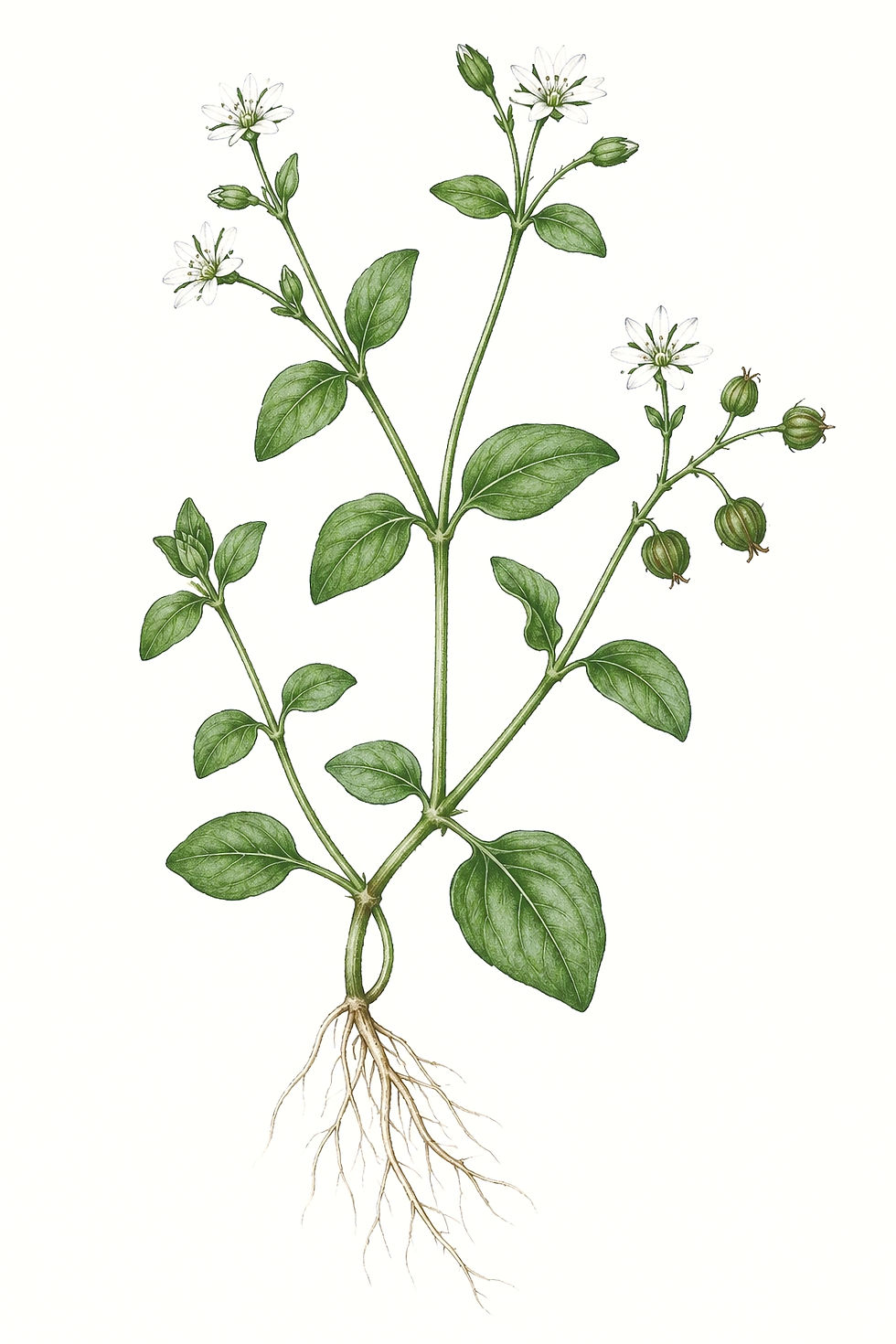
Chickweed
Stellaria media
Element: Water + Earth
Threshold: There are times when healing doesn't arrive with great force, but with quiet persistence. Chickweed reminds us that gentle nourishment and steady care often restore what urgency cannot.
Keeper's Note
Chickweed is one of those humble plants that asks for very little attention, yet quietly offers so much in return. It carpets gardens, forest edges, and pathways with soft green abundance, appearing when the earth is cool and moist. Often dismissed as a common weed, it has long been welcomed by herbalists who recognized its generous nature. Chickweed teaches that some of the greatest gifts are found in the plants growing faithfully beneath our feet.
Traditional Uses
For generations, chickweed has been valued as a cooling, soothing herb. Traditionally, the fresh herb was prepared as poultices, salves, infused oils, and washes to comfort irritated or dry skin. Herbalists also enjoyed chickweed as a nourishing spring green, adding the tender leaves to salads, soups, and tonics as a seasonal food after winter. It has long been appreciated as a gentle herb associated with supporting the body's natural processes of balance and renewal.
Where It Grows
Chickweed is native to Europe but has become naturalized throughout much of North America and many temperate regions around the world. It thrives in cool, moist soils and is commonly found in gardens, fields, woodland edges, lawns, cultivated ground, and disturbed areas. It flourishes during the cooler months of spring and autumn and often remains green long after many other plants have faded.
How to Harvest
Harvest the fresh aerial parts while the plant is young, vibrant, and flowering. Snip stems above the root system, allowing the plant to continue growing and reseeding naturally. Gather only from clean areas free of pesticides, roadside contamination, and pet activity. Chickweed is best used fresh, though it may also be carefully dried or infused into oils soon after harvesting to preserve its delicate qualities.
Gentle Safety Note
Chickweed has a long history of traditional culinary and herbal use and is generally considered a gentle herb for most people when properly identified. As with any wild plant, careful identification is essential before harvesting. Individuals with plant sensitivities or allergies should use caution when trying it for the first time, and any persistent health concerns should be discussed with a qualified healthcare professional

Chicory
Cichorium intybus
Element: Earth
Threshold: Not everything that strengthens us is sweet. Some gifts arrive with a gentle bitterness that awakens gratitude, steadies the spirit, and reminds us that resilience often grows through life's simplest offerings.
Keeper's Note
Chicory stands with quiet confidence along roadsides and open fields, lifting its sky-blue blossoms toward the morning sun while its roots reach deeply into the earth. Though often overlooked as a common wildflower, it has nourished both body and spirit for centuries. From its sturdy root to its delicate flowers, chicory reminds us that true strength is often rooted beneath the surface, patiently waiting to be discovered.
Traditional Uses
Traditionally, chicory root has been roasted and brewed as a coffee substitute or blended with coffee, particularly during times when coffee was scarce. Herbalists have long valued the root as a traditional bitter herb to support healthy digestion and appetite, while the young leaves were gathered as a nutritious spring green. Throughout history, chicory has been appreciated as both a wholesome food and a respected medicinal plant in European and North American herbal traditions.
Where It Grows
Native to Europe, western Asia, and northern Africa, chicory has become widely naturalized throughout North America and many other temperate regions. It thrives in sunny, well-drained soils and is commonly found along roadsides, meadows, pastures, fields, and disturbed ground. Its deep taproot allows it to flourish even in dry conditions where many plants struggle.
How to Harvest
Harvest the young leaves in early spring before they become overly bitter. The roots are best dug in autumn after the plant's energy has returned below ground, or in early spring before flowering begins. Leave plenty of mature plants to flower and produce seed, supporting pollinators and ensuring healthy future populations. Clean roots thoroughly before drying or roasting for later use.
Gentle Safety Note
Chicory has a long history of safe culinary and traditional herbal use. As with many members of the daisy family, individuals with sensitivities to plants in the Asteraceae family should introduce it with care. Those who are pregnant, breastfeeding, or managing ongoing health conditions should consult a qualified healthcare professional before using chicory medicinally.

Chives
Alliumm schoenoprasum
Element: Fire + Earth
Threshold: The smallest things often carry the greatest quiet strength. Chives remind us that steady nourishment and simple daily rituals can sustain us long after grand gestures have faded.
Keeper's Note
Chives are among the first herbs to awaken each spring, sending up slender green blades long before many other garden plants have stirred. Their cheerful purple blossoms invite bees, while their mild onion fragrance hints at the generous gifts they offer both the kitchen and the herb basket. Unassuming yet dependable, chives remind us that abundance is often found in the plants we return to again and again.
Traditional Uses
For centuries, chives have been valued as both a culinary and traditional medicinal herb. Their fresh leaves have long been added to meals to brighten flavour while gently supporting healthy digestion. Like other members of the allium family, they have traditionally been appreciated as nourishing spring greens and were often included in seasonal diets following the long winter months. The blossoms have also been used as an edible garnish and infused into vinegars for both flavour and beauty.
Where It Grows
Chives are native to Europe, Asia, and North America, making them one of the few herbs naturally found across much of the Northern Hemisphere. They thrive in rich, well-drained soil with full sun to partial shade and are commonly grown in gardens, herb beds, containers, and cottage landscapes. Once established, they return faithfully each spring and readily attract pollinating insects when in bloom.
How to Harvest
Harvest the leaves by cutting them close to the base with clean scissors, allowing the plant to continue producing fresh growth throughout the season. The flowers may also be gathered shortly after opening for culinary or herbal preparations. Avoid removing more than one-third of the plant at any one time, ensuring it remains healthy and vigorous for future harvests.
Gentle Safety Note
Chives have a long history of safe culinary use and are generally well tolerated by most people. As with all members of the allium family, individuals with sensitivities should introduce them gradually. While beneficial for people as a food herb, chives can be harmful to dogs and cats if consumed in significant amounts, so harvested plants should be kept out of reach of household pets.

Chrysanthemum
Chrysanthemum morifolium or indicum
Element: Water + Air
Threshold: There is wisdom in meeting the changing seasons with grace. Chrysanthemum reminds us that even as the year begins to soften, beauty, clarity, and quiet resilience continue to bloom.
Keeper's Note
Chrysanthemum arrives as many other flowers prepare to rest, bringing bright blossoms to the cooling days of late summer and autumn. For generations, it has been cherished not only for its beauty but also for its place in kitchens, gardens, and traditional herbal practices around the world. Gentle yet enduring, chrysanthemum encourages us to find calm within change and to recognize that every season carries its own quiet gifts.
Traditional Uses
Chrysanthemum flowers have been traditionally prepared as teas, infusions, and cooling beverages, particularly throughout East Asian herbal traditions. They have long been appreciated as a comforting herb enjoyed during warm weather and as a gentle addition to seasonal wellness practices. Beyond its herbal uses, chrysanthemum has also been cultivated for centuries as an ornamental flower, symbolizing longevity, honour, and perseverance in many cultures.
Where It Grows
Chrysanthemum is native to eastern Asia, particularly China, where it has been cultivated for well over a thousand years. Today, it is grown throughout temperate regions across the world in gardens, fields, and cultivated landscapes. It thrives in fertile, well-drained soil with full sun and rewards careful tending with abundant blooms late in the growing season.
How to Harvest
Harvest the flowers after they have fully opened but before they begin to fade. Pick on a dry morning after the dew has lifted, selecting healthy blossoms free from blemishes or insect damage. Dry the flowers promptly in a warm, well-ventilated place away from direct sunlight to preserve their quality. Always leave plenty of blossoms behind to support pollinators and allow the plant to complete its natural life cycle.
Gentle Safety Note
Only chrysanthemums grown specifically for culinary or traditional herbal use should be prepared as tea or herbal remedies, as ornamental varieties may have been treated with pesticides or other chemicals. Individuals with sensitivities to plants in the Asteraceae family should use caution when trying chrysanthemum for the first time. If you are pregnant, breastfeeding, or managing a medical condition, consult a qualified healthcare professional before using it medicinally.

Cilantro
Coriandrum sativum
Element: Air + Water
Threshold: Some plants ask us to embrace every stage of their journey. Cilantro reminds us that growth is not a single purpose but a continual unfolding, where leaves, flowers, and seeds each carry their own quiet gifts.
Keeper's Note
Cilantro is a plant of remarkable generosity, offering something useful from the moment its first tender leaves emerge until its seeds have fully ripened. Fresh and vibrant in spring, delicate with its airy white blossoms, and warmly aromatic as coriander seed, it has found a place in kitchens and apothecaries across countless cultures. Cilantro teaches us that transformation is not the loss of what came before, but the natural progression into something equally valuable.
Traditional Uses
For centuries, cilantro leaves and coriander seeds have been treasured as both food and traditional herbal allies. The fresh leaves have long been enjoyed to brighten meals, while the dried seeds have traditionally been prepared in teas, culinary blends, and digestive preparations. Herbal traditions throughout Europe, Asia, the Middle East, and the Americas have appreciated coriander seed as a warming, aromatic herb commonly used to support comfortable digestion and to flavour both sweet and savoury dishes.
Where It Grows
Believed to have originated in regions surrounding the Mediterranean and western Asia, cilantro is now cultivated throughout much of the world. It grows best in cool weather with rich, well-drained soil and full sun to partial shade. The plant thrives during the cooler months of spring and autumn, often bolting quickly as temperatures rise.
How to Harvest
Harvest the young leaves regularly while they are fresh and tender, taking only what the plant can readily replace. If growing for coriander seed, allow the flowers to bloom and the seed heads to mature fully before collecting them on a dry day. Leave some plants to flower for beneficial pollinators and to naturally reseed, ensuring future harvests.
Gentle Safety Note
Cilantro and coriander have a long history of safe culinary and traditional herbal use for most people. As with any herb, individuals with known sensitivities should introduce it gradually. Always harvest from plants that have not been treated with pesticides or other chemicals, and consult a qualified healthcare professional before using medicinal amounts if you are pregnant, breastfeeding, or managing an ongoing health condition.

Cinchona
Cinchona officinslid
Element: Fire + Earth
Threshold: Some of nature's greatest gifts are hidden beneath rugged bark and quiet endurance. Cinchona reminds us that strength is often discovered through patience, resilience, and a willingness to learn from the wisdom of the forest.
Keeper's Note
High in the cloud forests of South America grows a tree whose bark has shaped the course of herbal history. Cinchona is not a plant of abundance in the home garden, nor one gathered on a casual woodland walk. It is a reminder that some herbs ask us to approach with knowledge, gratitude, and restraint. For generations, its remarkable bark earned the respect of herbalists, explorers, and physicians alike, securing its place as one of the world's most historically significant medicinal trees.
Traditional Uses
For centuries, the bark of cinchona has been valued in traditional South American herbal practices. Indigenous peoples recognized its importance long before it became known throughout Europe. Dried bark was traditionally prepared as decoctions and bitter tonics and was highly regarded for its role during periods of fever and illness. In time, compounds isolated from cinchona bark, particularly quinine, became historically important in the treatment of malaria and greatly influenced the development of modern medicine.
Where It Grows
Cinchona is native to the misty cloud forests of the Andes Mountains in countries including Peru, Ecuador, Colombia, and Bolivia. It thrives at higher elevations where cool temperatures, abundant rainfall, and fertile mountain soils support its slow, steady growth. Today, it has also been cultivated in parts of Asia, Africa, and other tropical regions for the production of medicinal bark.
How to Harvest
Cinchona bark should only be harvested from cultivated trees using sustainable forestry practices. Historically, excessive harvesting placed many wild populations under significant pressure. Responsible cultivation now plays an important role in protecting these remarkable trees while providing bark for medicinal use. Wild harvesting should be avoided unless carried out under carefully managed conservation programs.
Gentle Safety Note
Cinchona is a powerful traditional medicinal tree rather than a general wellness herb. Because its bark contains naturally occurring quinine and related alkaloids, it should only be used under the guidance of a qualified healthcare professional. Cinchona may interact with certain medications and is not appropriate for everyone. It should not be used casually or in self-treatment without proper knowledge and supervision.

Cinnamon
Cinnamon verum (ceylon)
Element: Fire
Threshold: Warmth is more than heat—it is welcome, generosity, and quiet strength. Cinnamon reminds us that even the simplest comforts have the power to nourish both body and spirit.
Keeper's Note
There is something deeply familiar about the scent of cinnamon. It carries memories of shared tables, winter kitchens, and well-worn recipes passed from one generation to the next. Yet beyond its treasured place in the pantry, cinnamon has been revered for thousands of years as one of the world's most valued medicinal barks. Harvested from the inner bark of an evergreen tree, it reminds us that beneath every strong exterior lies something quietly generous waiting to be revealed.
Traditional Uses
For centuries, cinnamon has been treasured in traditional herbal systems throughout Asia, the Middle East, Europe, and Africa. The aromatic bark was commonly prepared as teas, decoctions, powders, and warming culinary spices. Herbalists have traditionally valued cinnamon as a warming herb associated with supporting healthy digestion, circulation, and seasonal wellness, while its rich fragrance has made it a favourite ingredient in both food and traditional herbal preparations.
Where It Grows
True cinnamon is native to Sri Lanka and parts of southern India, where it thrives in warm, humid tropical climates. Today, it is cultivated throughout many tropical regions, including Madagascar, the Seychelles, and parts of Southeast Asia. The evergreen trees flourish in rich, well-drained soil with abundant rainfall and warm temperatures throughout the year.
How to Harvest
Cinnamon is harvested by carefully cutting young branches and removing the outer bark to reveal the delicate inner bark beneath. As the inner bark dries, it naturally curls into the familiar quills used throughout the world. Responsible cultivation allows trees to regenerate through coppicing, providing repeated harvests while maintaining the health of the tree. Whenever possible, choose cinnamon from growers committed to sustainable harvesting practices.
Gentle Safety Note
Cinnamon has a long history of safe culinary use when enjoyed in typical food amounts. For herbal preparations, true cinnamon (Cinnamomum verum) is often preferred over cassia cinnamon because it naturally contains much lower levels of coumarin. Individuals taking blood-thinning medications, managing liver conditions, or considering concentrated cinnamon supplements should consult a qualified healthcare professional before medicinal use.

Cistus (Rockrose/Labdanum)
Cistus Ladanifer
Element: Air + Fire
Threshold: Resilience is not the absence of hardship, but the quiet ability to flourish where conditions seem impossible. Cistus reminds us that beauty and strength often take root in the most rugged places.
Keeper's Note
Cistus is a child of sun-warmed hillsides, where rocky soil, dry winds, and brilliant light shape its character. Its delicate blossoms may last only a single day, yet the plant itself returns faithfully year after year, cloaked in fragrant leaves rich with aromatic resin. There is a quiet lesson in its nature: lasting strength does not always appear dramatic. Sometimes it is found in the steady endurance that carries us through every season.
Traditional Uses
For centuries, cistus has been valued throughout the Mediterranean as both a medicinal and aromatic plant. Its leaves and resin, known as labdanum, have traditionally been prepared as herbal teas, infusions, and fragrant preparations. Historically, herbalists appreciated cistus as a comforting herb during seasonal illnesses and as a valued ingredient in traditional wellness practices. The resin has also been treasured for centuries in incense, perfumery, and ceremonial preparations because of its warm, balsamic fragrance.
Where It Grows
Cistus is native to the Mediterranean Basin, where it thrives on dry, rocky hillsides, open woodlands, coastal slopes, and scrublands. It flourishes in poor, well-drained soils under full sun and is remarkably drought tolerant once established. Today, it continues to grow throughout southern Europe, North Africa, and parts of western Asia.
How to Harvest
Harvest the young leaves and flowering tops during the blooming season on a dry morning after the dew has lifted. Gather only healthy growth, leaving plenty of flowers for pollinators and seed production. When collecting resin, it should be obtained only through traditional sustainable methods that avoid damaging the shrub. Always harvest respectfully, allowing wild stands to remain healthy and abundant.
Gentle Safety Note
Cistus has a long history of traditional herbal use and is generally considered a gentle herb when enjoyed as a tea or traditional preparation. As with any botanical, individuals with plant sensitivities should introduce it gradually. If you are pregnant, breastfeeding, taking medications, or managing an ongoing health condition, consult a qualified healthcare professional before using cistus medicinally.

Cleavers
Galium aparine
Element: Water + Earth
Threshold: Some paths are meant to be followed slowly. Cleavers reminds us that gentle movement, patient persistence, and quiet connection often accomplish what force never can.
Keeper's Note
Cleavers is a familiar companion of hedgerows, woodland edges, and untended gardens, reaching out with tiny hooked hairs that allow it to gently climb and weave itself among neighboring plants. Though often dismissed as a troublesome weed, herbalists have long recognized its quiet generosity. Soft, abundant, and nourishing, cleavers teaches that support is not always loud—it often arrives through gentle, steady presence.
Traditional Uses
For generations, cleavers has been valued as a traditional spring herb. The fresh aerial parts have long been prepared as teas, infusions, juices, and cooling herbal preparations. Traditional Western herbalists have appreciated cleavers as a gentle herb associated with supporting the body's natural processes of cleansing and fluid balance. Young shoots have also been enjoyed as a seasonal wild edible in some traditional food practices.
Where It Grows
Cleavers is native to Europe, Asia, and North Africa and has become naturalized throughout much of North America and other temperate regions. It thrives in moist, fertile soils and is commonly found in woodlands, hedgerows, gardens, fence lines, meadows, and disturbed ground. It grows vigorously in spring, often scrambling over surrounding vegetation before setting seed in early summer.
How to Harvest
Harvest the fresh aerial parts while the plant is young, tender, and before seeds begin to fully develop. Snip the upper portions of the stems, leaving the roots and lower growth intact so the plant can continue its natural cycle. Cleavers is most often used fresh, as its beneficial qualities diminish quickly after drying. Always gather from clean areas free from pesticides, roadside contamination, and pet activity.
Gentle Safety Note
Cleavers has a long history of traditional herbal use and is generally considered a gentle herb for most people when properly identified. Because it is most commonly prepared fresh, harvest only healthy plants from clean environments. As with any herb, individuals who are pregnant, breastfeeding, taking medications, or managing ongoing health conditions should consult a qualified healthcare professional before medicinal

Clove
Syzygium aromaticum
Element: Fire
Threshold: True warmth does more than comfort—it awakens. Clove reminds us that even the smallest gifts can carry remarkable strength when offered with purpose and care.
Keeper's Note
Cloves begin as unopened flower buds, carefully gathered before they ever have the chance to bloom. Dried beneath the tropical sun, they become one of the world's most treasured spices, filling kitchens and apothecaries alike with their unmistakable fragrance. Rich, warming, and deeply aromatic, clove has traveled across continents for centuries, reminding us that great value is often found in the smallest things.
Traditional Uses
For thousands of years, cloves have been valued throughout Asia, the Middle East, Africa, and Europe as both a culinary spice and traditional medicinal herb. The dried flower buds have traditionally been prepared in teas, warming herbal infusions, spice blends, and aromatic preparations. Herbalists have long appreciated cloves for their warming nature and their traditional association with supporting digestion, seasonal wellness, and oral care. Clove has also been widely used in preserving foods and creating fragrant herbal preparations.
Where It Grows
Clove is native to the Maluku Islands of Indonesia, often called the Spice Islands. Today, it is cultivated throughout many tropical regions, including Madagascar, Tanzania, Sri Lanka, India, and parts of Southeast Asia. The evergreen trees thrive in warm, humid climates with fertile, well-drained soils and abundant rainfall.
How to Harvest
Cloves are harvested by hand while the flower buds are still tightly closed and have just begun to change from green to a soft pink hue. The buds are carefully dried until they develop their familiar rich brown colour and concentrated aroma. Responsible cultivation supports the long-term health of the trees while allowing annual harvests without harming the plant.
Gentle Safety Note
Cloves have a long history of safe culinary use when enjoyed in normal food amounts. Because clove and clove essential oil are highly concentrated, medicinal use should be approached with care. Clove essential oil should never be applied undiluted to the skin or taken internally without appropriate guidance. Individuals taking blood-thinning medications, preparing for surgery, or managing certain health conditions should consult a qualified healthcare professional before using cloves medicinally.

Coltsfoot
Tussilago farfara
Element: Air + Earth
Threshold: Hope often arrives before the landscape appears ready to receive it. Coltsfoot reminds us that even after the longest winter, life quietly finds its way back to the light.
Keeper's Note
Long before its leaves appear, bright yellow flowers push through cold soil, announcing the arrival of spring with quiet determination. Coltsfoot has been a familiar sight along roadsides, stream banks, and disturbed ground for generations, offering one of the earliest blooms of the season. Its patient resilience reminds us that renewal does not wait for perfect conditions—it simply begins.
Traditional Uses
For centuries, coltsfoot has held an honoured place in traditional European and Asian herbalism. The flowers and leaves were commonly prepared as teas, syrups, and infusions and were traditionally valued as soothing herbs for the respiratory system. Throughout history, herbalists have appreciated coltsfoot during seasonal discomforts involving the throat and chest, making it one of the best-known traditional herbs for respiratory wellness.
Where It Grows
Coltsfoot is native to Europe and parts of Asia and has become naturalized throughout much of North America. It thrives in moist, disturbed soils and is commonly found along roadsides, riverbanks, gravel pits, woodland edges, embankments, and open fields. The cheerful yellow flowers emerge in early spring before the large, heart-shaped leaves develop later in the season.
How to Harvest
Harvest the flowers soon after they open on a dry morning, gathering only healthy blooms. The young leaves may be collected once they have fully expanded but before they become weathered or damaged. Always leave plenty of flowers for early pollinators and allow established patches to continue spreading naturally. Harvest only from clean areas free from roadside pollutants, herbicides, and pesticides.
Gentle Safety Note
Coltsfoot has a long history of traditional herbal use; however, it naturally contains pyrrolizidine alkaloids (PAs), compounds that may pose a risk to the liver with prolonged or excessive use. Modern herbalists generally recommend using only PA-free cultivated preparations when available and avoiding long-term internal use. Individuals who are pregnant, breastfeeding, have liver conditions, or are taking medications should consult a qualified healthcare professional before using coltsfoot medicinally.

Comfrey
Symphytum officinale
Element: Water + Earth
Threshold: Healing is not always hurried. Comfrey reminds us that true restoration is built layer by layer, through patience, care, and a willingness to honour the body's natural rhythms.
Keeper's Note
Comfrey is a plant of quiet abundance, growing with broad, velvety leaves and deep-reaching roots that draw nourishment from far beneath the soil. For centuries, it has been one of the most respected herbs in the traditional herbalist's garden, valued not only for its generous growth but for its enduring place in herbal preparations. Comfrey teaches us that strength often comes from what is deeply rooted, unseen, and patiently cultivated.
Traditional Uses
Comfrey has a long history of traditional use, particularly as an externally applied herb. The leaves and roots were commonly prepared as poultices, infused oils, salves, compresses, and washes to soothe and comfort the body. Throughout European folk herbalism, comfrey became one of the best-known herbs for supporting the body's natural processes of tissue repair. Young leaves were also occasionally eaten in small amounts historically, although this practice is no longer generally recommended.
Where It Grows
Comfrey is native to Europe and parts of western Asia and has become naturalized throughout many temperate regions, including North America. It thrives in moist, fertile soils and is commonly found near streams, ditches, meadows, woodland edges, and cultivated gardens. Once established, its deep taproot allows it to return reliably year after year.
How to Harvest
Harvest the leaves throughout the growing season by cutting mature leaves near the base, allowing the crown to continue producing new growth. Roots are traditionally harvested in autumn after the plant's energy has returned below ground. Because comfrey is an important nectar source for bees and other pollinators, leave plenty of flowers to support local wildlife. Harvest only healthy plants growing in clean, uncontaminated areas.
Gentle Safety Note
Comfrey has a long and respected history in traditional herbalism, but modern research has identified naturally occurring pyrrolizidine alkaloids (PAs) that may pose a risk to the liver if taken internally. For this reason, modern herbal practice generally recommends comfrey for external use only, particularly on intact skin. It should not be applied to deep puncture wounds, and individuals who are pregnant, breastfeeding, have liver conditions, or are considering medicinal use should consult a qualified healthcare professional.

Copaiba
Copaifera officinalis
Element: Earth + Water
Threshold: True strength does not always stand tall above the forest. Sometimes it flows quietly from within, offering steady support while asking only that we receive it with gratitude and respect
Keeper's Note
Deep within the tropical forests of South America grows the majestic copaiba tree, whose treasured resin has been gathered for generations without felling the tree itself. Drawn gently from the living trunk, this golden oleoresin reflects a relationship built on respect rather than taking. Copaiba reminds us that the most enduring gifts are those harvested with care, allowing both the giver and the receiver to continue flourishing.
Traditional Uses
For centuries, Indigenous peoples of the Amazon have valued copaiba resin as an important part of traditional herbal practice. The oleoresin has traditionally been applied externally in balms, salves, and topical preparations, while carefully prepared internal uses have also been documented within traditional systems. Throughout history, herbalists have appreciated copaiba for its soothing nature and its longstanding place in supporting the body's natural processes of comfort and restoration. It has also been widely incorporated into soaps, perfumes, and natural body care products.
Where It Grows
Copaiba trees are native to the tropical rainforests of Central and South America, particularly throughout Brazil, Peru, Colombia, Venezuela, and the Amazon Basin. They thrive in warm, humid climates with rich forest soils and may live for many decades, growing into large canopy trees that support diverse forest ecosystems.
How to Harvest
Copaiba oleoresin is traditionally harvested by carefully drilling a small opening into the trunk of a mature tree, allowing the resin to flow before the opening is sealed again so the tree can continue to thrive. Sustainable harvesting methods allow the same tree to be tapped repeatedly over many years without causing significant harm. Whenever possible, choose products sourced from responsible producers who support rainforest conservation and ethical harvesting practices.
Gentle Safety Note
Copaiba has a long history of traditional use, particularly in topical preparations. Essential oils and concentrated oleoresins are highly potent and should always be used according to appropriate safety guidelines. Individuals who are pregnant, breastfeeding, taking medications, or managing ongoing health conditions should consult a qualified healthcare professional before medicinal use. As with any topical botanical, perform a small patch test before more widespread application.

Copal
Protium spp. / Bursera spp. (resin source varies)
Element: Air + Fire
Threshold: Some gifts are carried on the air rather than held in the hand. Copal reminds us that even what rises and disappears can leave a lasting impression upon the heart
Keeper's Note
Copal is not a leaf, flower, or root, but a fragrant tree resin gathered from living forests where it has been treasured for thousands of years. Golden and luminous, it has long connected people to ceremony, reflection, and gratitude. Whether carried as fragrant smoke or admired in its hardened form, copal reminds us that the forest offers more than medicine—it offers moments of stillness that invite us to become fully present.
Traditional Uses
For centuries, copal has been revered throughout Central and South America as a ceremonial resin. Indigenous cultures traditionally burned copal as incense during spiritual gatherings, seasonal celebrations, and important community rituals. Beyond its ceremonial significance, it has also been used historically in aromatic preparations, varnishes, and traditional crafts. Its warm, balsamic fragrance has made it one of the most cherished natural resins in many cultures.
Where It Grows
Copal is harvested from several species of tropical trees found throughout Mexico, Central America, northern South America, and parts of the Caribbean. These trees thrive in warm forests with well-drained soils and seasonal rainfall. Depending on the species, the resin may be collected either as fresh sap from living trees or as naturally hardened resin found on the forest floor.
How to Harvest
Traditionally, copal is collected by making careful, shallow cuts into mature trees, allowing resin to slowly flow before hardening. In some regions, naturally fallen resin is gathered from beneath the trees. Sustainable harvesting is essential, as excessive tapping can damage the tree and reduce its long-term health. Whenever possible, choose copal sourced from ethical harvesters who protect both the trees and the surrounding forest.
Gentle Safety Note
Copal has a long history of traditional use as an aromatic resin and incense. When burned, it should always be used in a well-ventilated space and with appropriate fire safety. Individuals with respiratory sensitivities may wish to avoid prolonged exposure to any type of smoke. Copal is generally intended for aromatic and ceremonial use rather than internal consumption unless under the guidance of a qualified practitioner.

Coriander
Coriandrum sativum
Element: Water + Earth
Threshold: Every ending carries the promise of a beginning. Coriander reminds us that what first appears as an ending may simply be another stage of growth, each season offering its own quiet abundance.
Keeper's Note
Coriander is the mature seed of the cilantro plant, completing a graceful journey from tender spring leaves to fragrant golden harvest. While the fresh herb brings brightness and vitality, the seeds offer warmth, depth, and quiet steadiness. Long treasured in both the kitchen and the apothecary, coriander reminds us that every stage of a plant's life holds its own purpose, each gift arriving precisely when it is needed.
Traditional Uses
For thousands of years, coriander seed has been valued throughout Europe, Asia, North Africa, and the Middle East as both a culinary spice and a traditional herbal remedy. The aromatic seeds have commonly been prepared as teas, decoctions, digestive tonics, and spice blends. Herbalists have long appreciated coriander as a gentle warming herb traditionally associated with supporting comfortable digestion and enhancing the flavour of both sweet and savoury foods.
Where It Grows
Coriander originates from the Mediterranean region and western Asia but is now cultivated throughout temperate climates around the world. It grows best in fertile, well-drained soil with full sun to partial shade. After flowering, the delicate white blossoms mature into small, round seed clusters that dry naturally on the plant before harvest.
How to Harvest
Allow the seed heads to mature fully on the plant until they turn light brown and begin to dry. Cut the stems on a dry day and hang them upside down inside a paper bag or bundle them to finish drying. Once fully dry, gently separate the seeds and store them in an airtight container away from heat and light. Leave some seed heads behind to naturally reseed and to provide food for birds and beneficial insects.
Gentle Safety Note
Coriander has a long history of safe culinary and traditional herbal use and is generally well tolerated by most people. As with any herb or spice, individuals with known sensitivities should introduce it gradually. If you are pregnant, breastfeeding, taking medications, or managing an ongoing health condition, consult a qualified healthcare professional before using coriander medicinally.

Corn Silk
Zea mays
Element: Earth + Water
Threshold: The most overlooked parts often carry quiet purpose. Corn silk reminds us that even the finest threads of life can hold remarkable value when we take the time to notice them.
Keeper's Note
Nestled beneath the protective husks of each ear of corn, the long golden silks are often discarded without a second thought. Yet for generations, these delicate strands have been gathered with care and respect by herbalists who recognized their quiet gifts. Corn silk teaches us that usefulness is not always found in what is most visible—sometimes the gentlest offerings are hidden just beneath the surface.
Traditional Uses
Corn silk has been valued in traditional herbal practices throughout North America, Europe, and Asia for centuries. The fresh or dried silks have commonly been prepared as teas, infusions, and gentle herbal beverages. Traditional herbalists have long appreciated corn silk as a soothing herb associated with supporting the body's natural urinary functions and maintaining healthy fluid balance. It has remained a trusted household herb because of its gentle nature and simple preparation.
Where It Grows
Corn silk comes from cultivated maize, a plant originating in Central America that is now grown throughout temperate and tropical regions worldwide. Corn thrives in fertile, well-drained soil with full sun and warm growing conditions. The silky styles emerge from each developing ear during midsummer and gradually darken as the kernels mature.
How to Harvest
Harvest the fresh silk when the ears are young and the strands are still soft, pale green to golden, and free from browning. Gently pull the silks from healthy ears without damaging the developing kernels whenever possible. Dry the silk promptly in a warm, well-ventilated location away from direct sunlight and store it in an airtight container until needed. Choose corn grown without pesticides or chemical treatments whenever harvesting for herbal use.
Gentle Safety Note
Corn silk has a long history of traditional herbal use and is generally considered a gentle herb for most people. Individuals with allergies to corn should use caution, and anyone taking diuretic medications or managing kidney or heart conditions should consult a qualified healthcare professional before using corn silk medicinally. As with all herbs, moderation and appropriate guidance are encouraged.

Cramp Bark
Viburnum opulus
Element: Water + Earth
Threshold: There is strength in learning when to soften. Cramp bark reminds us that resilience is not always found in holding tightly, but sometimes in allowing tension to gently release.
Keeper's Note
Cramp bark is a graceful woodland shrub that offers beauty in every season—from its delicate lace-like blossoms in spring to clusters of brilliant red berries in autumn. Beneath its modest appearance lies a bark that has been respected by herbalists for generations. Patient and steady, cramp bark reminds us that nature often restores balance not through force, but through gentle easing and quiet support.
Traditional Uses
For centuries, the bark of cramp bark has been valued in traditional North American and European herbalism. The bark has commonly been prepared as decoctions, tinctures, and herbal extracts and has long been appreciated for its traditional association with supporting the body's natural muscular relaxation. Herbalists have historically turned to cramp bark during times of temporary muscular tension and discomfort, making it one of the best-known traditional antispasmodic herbs.
Where It Grows
Cramp bark is native to Europe, northern Asia, and parts of North Africa and has become widely naturalized throughout North America. It thrives in moist woodlands, hedgerows, streambanks, forest edges, and cultivated gardens. The shrub prefers fertile, well-drained soils with full sun to partial shade and is admired for its ornamental flowers and persistent winter berries.
How to Harvest
The bark is traditionally harvested from young branches in early spring before vigorous new growth begins, or in late autumn after the leaves have fallen. Only small amounts should be taken from each shrub to avoid causing unnecessary harm, allowing the plant to continue growing vigorously. Harvest from healthy, mature shrubs growing in clean environments, and never strip bark completely around a branch or trunk.
Gentle Safety Note
Cramp bark has a long history of traditional herbal use and is generally considered a gentle herb when prepared appropriately. The bright red berries are not commonly used medicinally and may cause digestive upset if consumed in quantity. Individuals who are pregnant, breastfeeding, taking medications, or managing ongoing health conditions should consult a qualified healthcare professional before using cramp bark medicinally.